
 14 hours ago
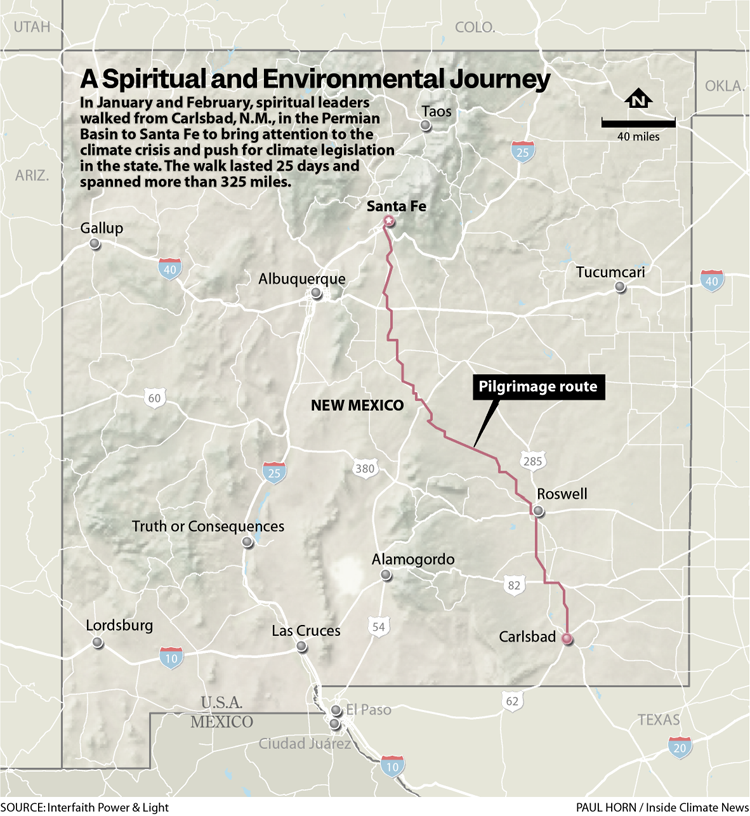
Oil and gas wells might seem unusual destinations for religious pilgrims, but on January 12, three faith-driven environmentalists began a 328-mile trek from Carlsbad, New Mexico. Their journey took them on foot past fossil-fuel developments, through remote ranch lands, and deep into the desert, all the way to the state capitol in Santa Fe.
The trio, representing New Mexico Interfaith Power & Light (NM-IPL), aimed to connect with communities and advocate for the Clear Horizons Act (SB18) during their 25-day journey. The bill proposed a 45 percent reduction in greenhouse gas emissions below 2005 levels by 2030 and net-zero emissions by 2050. NM-IPL is part of the Clear Horizons New Mexico coalition, which includes about three dozen organizations.
Although SB18 was ultimately defeated in the Senate on February 11, with several Democrats joining Republicans to block it, the Rev. Clara Sims, NM-IPL’s assistant executive director, emphasized that the pilgrimage was about more than just one legislative outcome.
“Taking an act of faith like this and even just being people of faith in general means that we believe in the power of things that aren’t totally measurable to have these currents or ripple effects that might—even years or decades down the line—plant a seed in someone else to have the courage to take an action,” said Sims, associate minister for First Congressional United Church of Christ Albuquerque.
A Toxic Legacy
In the early days of their journey, the group passed through southeastern New Mexico’s Permian Basin, the highest-producing oil field in the United States. In Carlsbad, a town of about 30,000 heavily reliant on the oil and gas industry, they spoke with a man who had retired after more than 40 years in the sector.
“He is grateful for his pension, but also has friends whose health have been impacted by the toxic chemicals that go along with the industry,” NM-IPL shared in their blog. “He particularly emphasized the dangers of hydrogen sulfide, which accompanies the flaring of gas.”
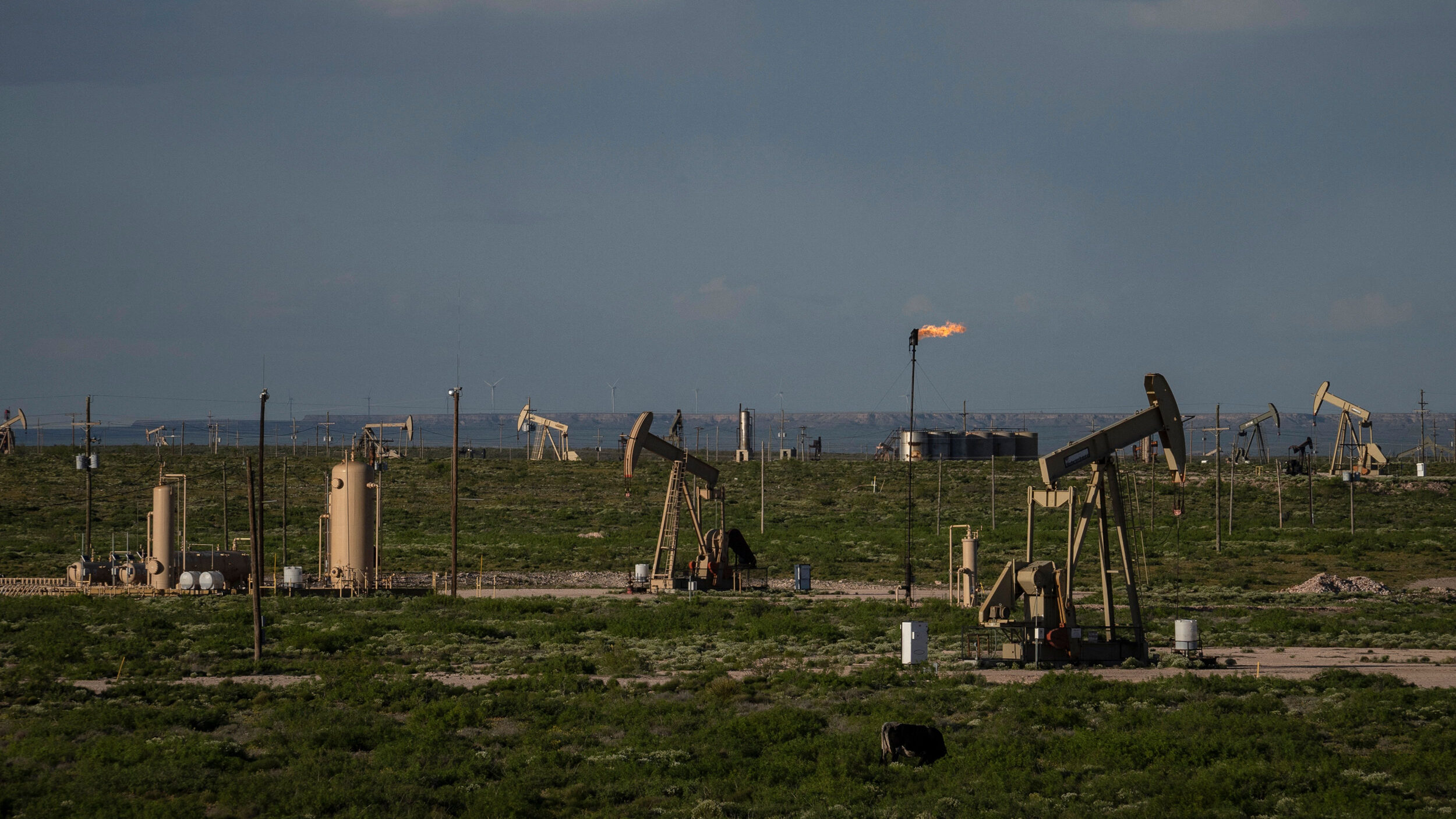 Pump jacks operate in a Permian Basin oilfield near Eddy County, New Mexico. Credit: Paul Ratje/AFP via Getty Images
Prolonged or repeated exposure to hydrogen sulfide has been linked to weight loss, chronic cough, and low blood pressure, according to the Centers for Disease Control and Prevention. The agency also notes some evidence suggesting exposure may increase miscarriage risk. Another study connected chronic exposure in natural gas processing plants to rare blood disorders like methemoglobinemia and sulfhemoglobinemia.
Acute exposure can cause skin and eye irritation, which NM-IPL’s executive director Desirée Bernard suspects she experienced while walking through New Mexico’s oil and gas country.
“I started to get a stinging sensation in my eyes,” she said. “I think it was from exposure to the air.”
Burning oil and gas is a major contributor to climate change. New Mexico faces heightened risks of drought and dangerous heat waves as global temperatures rise. The state is already enduring a historic megadrought that has severely depleted major waterways, including the Rio Grande.
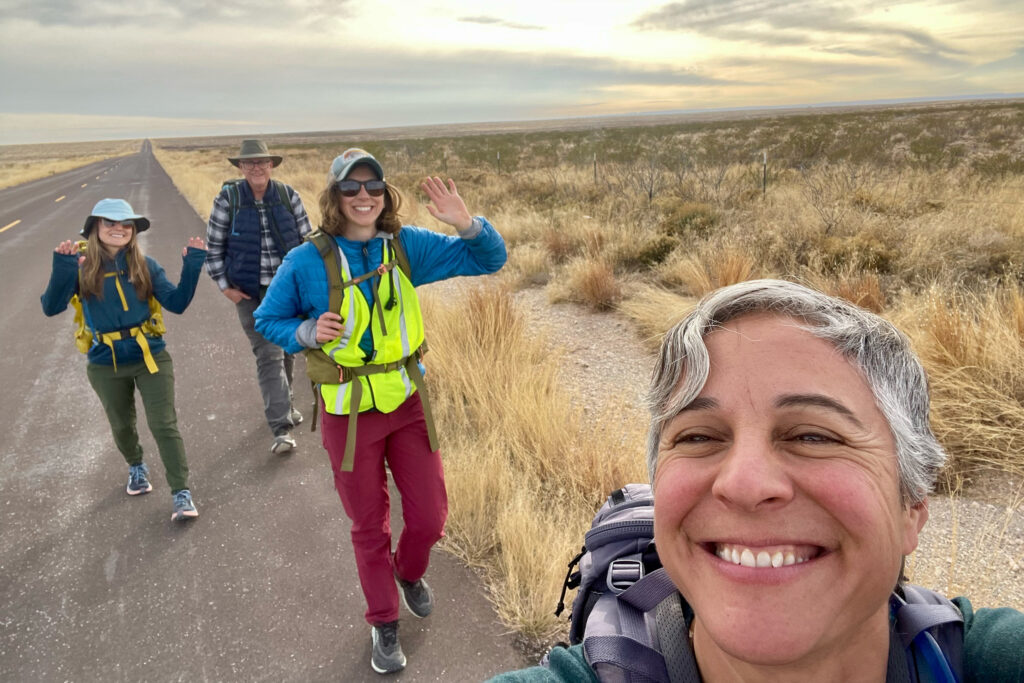 The group of pilgrims set out from Carlsbad on the first day of their journey. Credit: Desirée Bernard
“A Way of Generating Goodness”
Christians, Jews, Muslims, Hindus, Buddhists, and followers of other faiths have undertaken pilgrimages for centuries.
“It’s an old-school thing that humans do and I can see why. It has a way of generating goodness in the world,” said Bernard, who was born into a Catholic family, is married to a Christian minister, and describes her own faith as a “meandering spiritual path.”
A recent example is a group of Buddhist monks who completed a 2,300-mile Walk for Peace to Washington D.C. on February 10. NM-IPL’s marketing and communications representative Jim Ekstrand, based in Santa Fe and part of the United Church of Santa Fe, called this more-than-100-day pilgrimage “incredibly inspiring.”
Religious groups have increasingly used pilgrimages to support environmental causes. In November 2025, the Diocese of San Diego Creation Care Ministry organized a two-day, 27-mile pilgrimage with 50 walkers to the Salton Sea, a landlocked body of water in Southern California that has declined in recent years. Like NM-IPL’s pilgrimage, the event included prayers and reflections on environmental challenges, such as pesticide runoff from Imperial Valley agriculture.
 Buddhist monks line up during their March for Peace at the Peace Monument to greet U.S. Congress members on day 109 of their journey on Feb. 11 in Washington, D.C. Credit: Heather Diehl/Getty Images
“With the increasing heat and drought climate change is bringing, it’s evaporating all that toxicity into the atmosphere,” said Christina Bagaglio Slentz, associate director in the Office of Life Peace and Justice for the Diocese of San Diego. “So it’s affecting the people that live in the region.”
The Catholic Diocese of San Bernardino, covering the area north of San Diego, also organized a similar pilgrimage with about 50 participants. The two groups—one moving north and the other south—met in a small community along the route.
These pilgrimages were inspired by the 2025 Jubilee and Catholic Pilgrims of Hope for Creation, an initiative focusing on faith and environmental stewardship. It celebrated the 10th anniversary of Laudato Si’, Pope Francis’ second encyclical on care for our common home, and the 800th anniversary of St. Francis of Assisi’s Canticle of the Creatures. More than 230 pilgrimages took place across the U.S. that fall.
“It was pretty amazing,” Bagaglio Slentz said of her group’s journey to the Salton Sea. “I think our youngest participant was 7 and our oldest was like 86. So it was people of various ages and walks of life.”
Several environmental pilgrimages also occurred in September 2025 in the U.K., including the Three-Ports Pilgrimage in Bristol. This included a train ride to nearby Portishead, a 6-mile walk, and a bus ride back to Bristol.
“We stopped six times to pray and sing, focusing on different forms of transport and how they impact people and the environment,” the group wrote in a blog post. “We also got to know one another better, and heard lots of inspiring stories about different actions some of us had taken part in.”
Almost all religions teach respect for the environment, from Buddhism, which views nature as a living system essential to human existence, to Christianity, where humans are called to be stewards of the Earth.
This story is funded by readers like you.
Our nonprofit newsroom provides award-winning climate coverage free of charge and advertising. We rely on donations from readers like you to keep going. Please donate now to support our work.
Donate Now
Pope Francis has highlighted climate issues to more than 1.2 billion Catholics worldwide throughout his papacy, most notably with Laudato si’.
“A very solid scientific consensus indicates that we are presently witnessing a disturbing warming of the climatic system…” he wrote in the 2015 papal letter. “Humanity is called to recognize the need for changes of lifestyle, production and consumption, in order to combat this warming or at least the human causes which produce or aggravate it.”
Environmental coalitions are increasingly including faith-based groups in their campaigns. Sims believes this is beneficial, as religious communities offer unique perspectives.
“I think that people of faith and sort of spiritual grounding have a particular way in which they can sometimes bring a greater depth to some of these conversations in terms of really stepping back and maybe asking the bigger, deeper questions,” she said. For example, “What are the moral implications of what is happening?”
Praying for Change
“Moisture.”
That was one rancher’s quick response when Bernard explained the New Mexico pilgrimage supporting the Clear Horizons Act and asked what his prayer might be. She met him while walking along a dirt road near Corona, a small village about 90 miles southeast of Albuquerque.
Over the past decade, drought has made working his land difficult, he said. On that day, the rancher, driving a large white truck and wearing a sturdy jacket and black cowboy hat, was hauling supplemental feed. He explained that foraging is tough for his herd when the land is so dry.
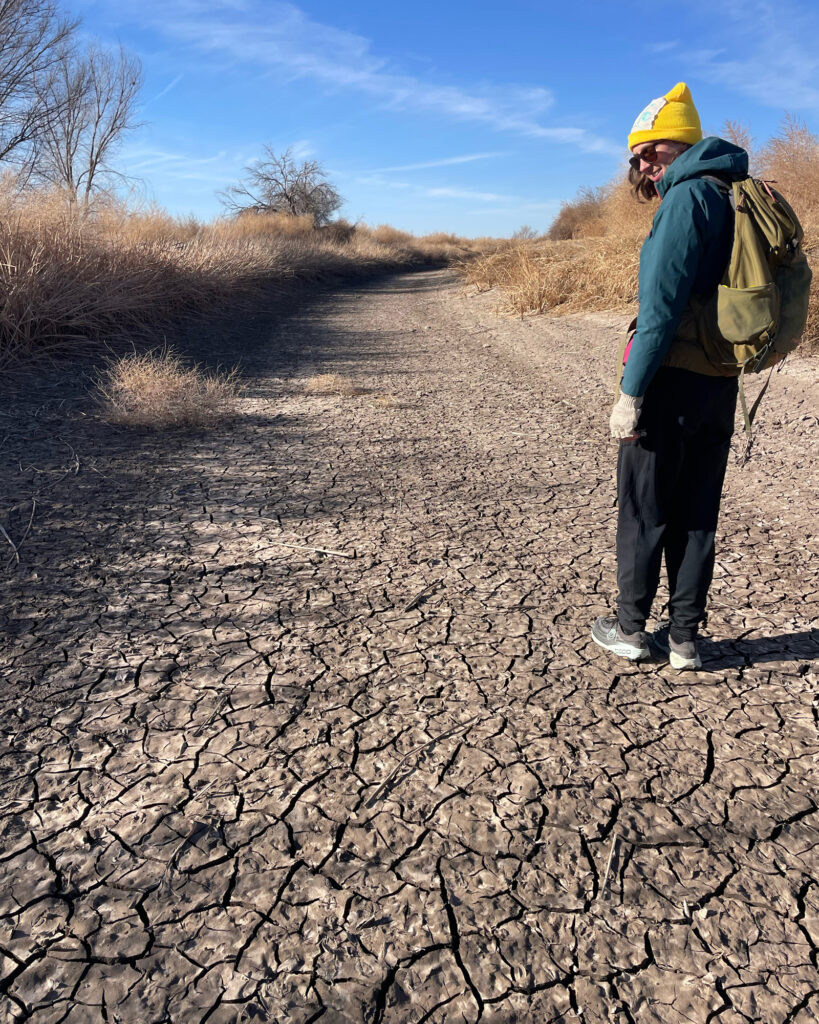 Rev. Clara Sims looks down at parched land during the group’s journey across New Mexico. Credit: Desirée Bernard
He’s not the only New Mexican hoping for a wetter future, Bernard added.
“[Water concerns] also showed up a lot in the written prayers that we received from people,” she said. During their journey, the group carried about 50 such prayers sent to them.
They shared copies of these prayers with their “climate champions,” including SB18’s primary sponsor, Mimi Stewart (D-Albuquerque), other co-sponsors, legislators seen as potential swing votes, and members of the Clear Horizons New Mexico Coalition.
Prayer was central to the pilgrimage. One day, Joyce Skeet joined the group, sharing that she felt compelled to pray for forgiveness for the harm humanity has caused the Earth. The pilgrims adopted this theme for their devotions as they began their trek northward from Corona that morning.
“It was very meaningful to share in that as we walked,” said Bernard. “To share in that sense of the confessional aspect of our complicity in the harm of the world.”
While trekking near Corona, they passed a massive wind farm, part of the SunZia Wind and Transmission Project. When completed, it will generate 3.5 gigawatts, powering over 3 million homes—primarily in California and Arizona—and be the largest renewable energy project in the Western Hemisphere. With hundreds of turbines across the landscape, Ekstrand described this area as a stark contrast to the Permian Basin.
Along the way, local communities welcomed the pilgrims, offering places to sleep in churches and homes. Sometimes they camped or stayed in hotels. Early in the journey, they shared a meal with a family who immigrated from Oaxaca, Mexico. Near the end, Rabbi Nahum Ward-Lev and Shelley Mann-Lev of Santa Fe hosted a “pop-up, sit down Shabbat dinner” at a Quality Inn in Moriarty. They later joined Father Michael Coburn at the Church of Holy Cross in Edgewood for another Shabbat gathering.
The walk had its challenges. Ekstrand’s wife fell ill with pneumonia early on and was hospitalized.
“So I had to leave on the second day to be with her,” he said. “She’s recovering very well now, thankfully. And then I was able to rejoin for the last several days.”
Sims experienced physical pain during the walk, especially in her back, but found being outdoors and breathing fresh air cathartic.
“I got to a place where I was like, ‘Wait, did I just heal my body with all the pain? Now my back feels better,’” she said. “I don’t know, I just started to feel good.”
Ekstrand agreed that despite difficulties, the trek was rejuvenating.
“The days I did it, even though the miles were long, for me, it felt surprisingly refreshing in a way to break the daily routine and get out on the road and do those long walks,” he said. “So physically, it didn’t feel tremendously demanding.”
The final leg was a short walk from a Santa Fe trailhead to a local church, followed by a march to the Roundhouse—New Mexico’s State Capitol—for Climate Solutions Day on February 5. The Sierra Club-sponsored event included meetings with legislators, lobbying training, committee hearings, and a noon rally.
“There was a really heartening crowd as we were coming into Santa Fe,” Bernard said. “I think it was between 70 or 80 at that last location at the little church before we went on to the Roundhouse.”
Though enthusiastic about the trek and sharing Sims’ belief in its potential to create ripple effects, Bernard expressed disappointment over the Clear Horizons Act’s failure.
“There are consistently folks who should know better who are just voting with oil and gas,” she said. “And it’s depressing, really. We need to replace those people because at this point, we don’t actually have the luxury of having state leadership that is not going to rise to the occasion with what we’re doing to our planet.”
About This Story
This story, like all news published by Inside Climate News, is free to read because we are a 501(c)(3) nonprofit organization. We do not charge subscription fees, lock content behind paywalls, or display ads. Our award-winning climate coverage is freely available to anyone who wants it.
We also share our reporting with many other media organizations nationwide, many of which cannot afford environmental journalism on their own. We have bureaus coast to coast to report local stories, collaborate with local newsrooms, and co-publish articles to ensure this vital work reaches as many people as possible.
Founded in 2007 by two journalists, we earned a Pulitzer Prize for National Reporting six years later. Today, we are the oldest and largest dedicated climate newsroom in the U.S., telling complex stories, holding polluters accountable, exposing environmental injustice, debunking misinformation, scrutinizing solutions, and inspiring action.
Donations from readers like you fund every aspect of our work. If you don’t already, please support our ongoing reporting on the biggest crisis facing our planet and help us reach more readers in more places.
Please take a moment to make a tax-deductible donation. Every contribution makes a difference.
Thank you,


