 1 day ago
Science advocates and UCLA Faculty Association members called on Californians to support a bill that would put scientific research funding on the 2026 ballot at a Saturday protest in Westwood.
About 40 protesters gathered outside the Wilshire Federal Building at noon on Saturday for the second annual Stand Up For Science protest. Attendees listened to speeches during the first hour before marching to the intersection of Wilshire Boulevard and Veteran Avenue at 1 p.m.
[Related: Over 1,000 people protest executive orders at Stand Up For Science rally Friday]
Stand Up For Science (SUFS), a nonprofit advocacy group, organized protests in cities nationwide on Saturday, including Washington, D.C., New York City, and Chicago. These demonstrations are part of a campaign launched in February 2025 in response to threats against federal science agencies, research funding, and public health infrastructure under the Trump administration.
SUFS coordinated the Los Angeles protest alongside the UCLA Faculty Association.
In late July, the federal government suspended $584 million of UCLA’s research grants from the National Institutes of Health, the National Science Foundation, and the U.S. Department of Energy. Although a federal judge temporarily reinstated most of the frozen grants in August and September, more than $230 million in research funding remained suspended as of January 8, 2026, according to the UC Office of the President.
[Related: Federal government suspends research funding to UCLA]
Speakers urged attendees to support California Senate Bill 895, which would add a proposition to the November 2026 ballot to establish the California Foundation for Science and Health Research. If approved, the foundation would allocate $23 billion, raised through state bond sales, to scientific research projects.
[Related: UC sponsors state Senate bill that proposes $23 billion research bond]
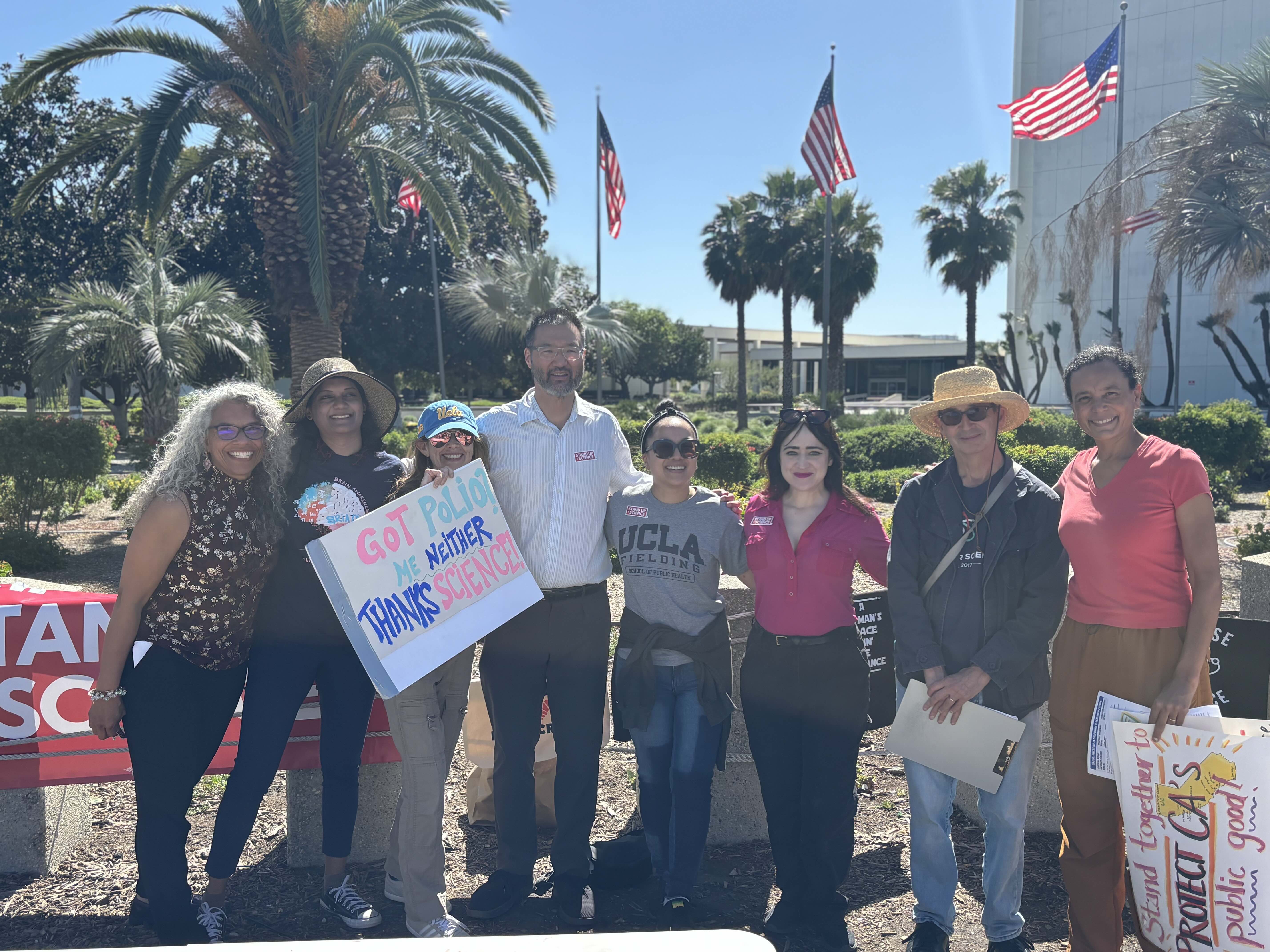 Protesters, including members of the UCLA Faculty Association and Stand Up For Science, are pictured. (Nicholas Mouchawar/Daily Bruin)
Dave Farina, a science educator with 4.2 million YouTube subscribers known for his channel "Professor Dave Explains," opened the rally by condemning what he described as a growing anti-science sentiment within the federal government. According to The New York Times, approximately 95,000 employees left federal science agencies during the first year of the second Trump administration.
"Science denial in the government is not brand new. We've had Republican senators denying climate change—or even evolution—for as long as I've been alive," Farina said. "But what we've never had is an administration that pushes dangerous medical misinformation through the White House, NIH, CDC, and FDA."
Monique Trinh, a program manager in pathology and laboratory medicine at UCLA’s David Geffen School of Medicine, shared that scientific research enabled her mother to participate in clinical trials after her cancer treatments ceased to be effective.
"Science is not abstract to me. Science is my mom, science is hope, science is the reason families like mine were given time we might not otherwise have had," Trinh said. "Now the question is whether we will protect the system that made that possible. When we protect science, we protect people, and when we work together, we ensure that knowledge continues to move humanity forward."
Aradhna Tripati, a UCLA climate scientist and professor of Earth, planetary, and space sciences, explained that she leads a geochemistry laboratory focused on studying past climate change and its relevance to the current climate crisis. However, her research team recently lost millions in grant funding.
"My team lost $10 million in grant funding, and that's not because the science wasn't good but because somebody in D.C. decided we were expendable and our research was expendable," Tripati said.
She encouraged attendees to support SB 895 as a safeguard for California’s research infrastructure amid federal funding uncertainties.
Michael Chwe, a professor of political science and member of the UCLA Faculty Association executive board, credited advances in cancer treatment with helping him recover from melanoma.
Gina Poe, director of the UCLA Brain Research Institute, noted that federal research funding generates significant economic returns. Chwe added that providing California with its own research funding source would boost the state’s scientific innovation and economy.
"It's not a tax increase. It'll provide around $23 billion for science funding," Chwe said. "This basically creates an NSF or NIH just for California. That's going to be a tremendous boon for biotech, medicine, green technology, and drug prices. It's a really great thing."
Vidya Saravanapandian, a postdoctoral scholar at UCLA, emphasized the importance of scientific research in developing treatments for patients with rare disorders.
Saravanapandian shared her experience working with families of children with Dup15q syndrome—a rare genetic condition linked to autism, epilepsy, and motor impairment—and noted that UCLA research has already led to discoveries now used in clinical trials.
She also highlighted the economic impact of large public investments in research, citing California Proposition 71, a 2004 voter-approved initiative funding stem cell research, which generated billions in economic output and tens of thousands of jobs.
After the speeches concluded at 1 p.m., protesters marched along Wilshire Boulevard carrying signs supporting science funding and public health research.
"My mom believed in paying it forward. Today, standing here with all of you, I believe that is exactly what we are doing," Trinh said. "We are standing up for science not just for ourselves but for future patients, future students, and future generations who deserve the chance to learn, discover, and thrive."